OPM opens federal candidate lists across agencies, without re-ranking
The interim rule takes effect October 15, before comments close, and gives receiving agencies whatever remains on a non-extendable 240-day certificate
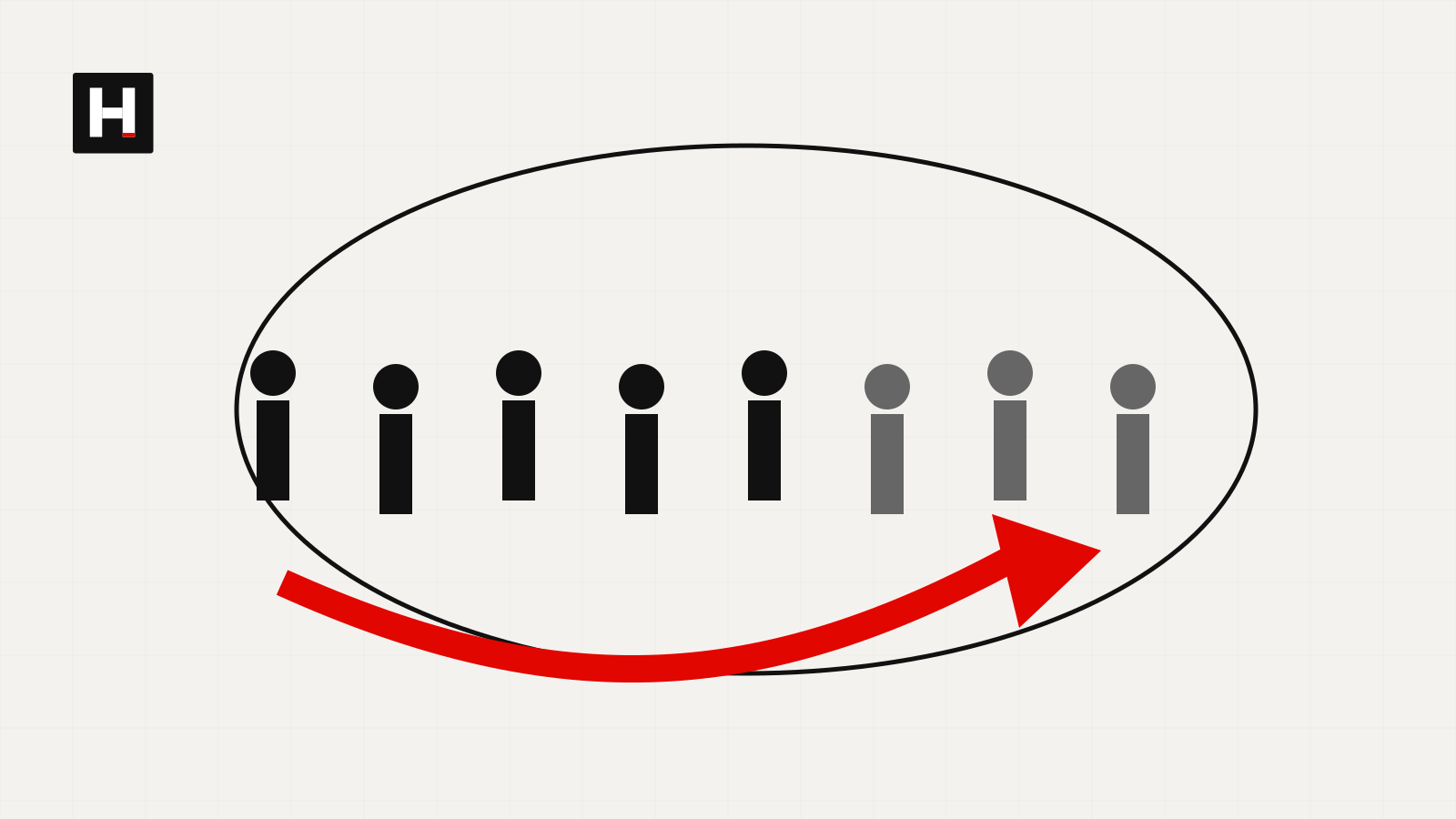
Starting October 15, an agency that runs a federal competitive examination can share the resulting certificate with other agencies, one after another or all at once, and receiving agencies that use it must use it in its original form. No re-rating. No re-ranking. Every action on that shared certificate is capped at 240 days, measured from the day the original hiring agency issued it.
That is the core of an interim rule the Office of Personnel Management published in the Federal Register on September 15, "Shared Certificates and Pooled Hiring Actions," 17 pages at 91 FR 58347. It amends three parts of the civil service regulations, 5 CFR 302, 332 and 337. Public comments are due November 16, a month after the rule starts operating, under a waiver of notice of proposed rulemaking. As of September 18, the docket showed one comment received.
The docket number is the tell: OPM-2017-0004. One section of the rule is devoted to OPM's responses to comments on a 2017 interim final rule. Nine years on, the agency is closing that loop and enlarging the authority at the same time.
Sharing runs sequentially or simultaneously, and a receiving agency working a simultaneously shared certificate may rely on another agency's sustained pass-over or three-considerations removal but is not required to, according to a provision-level summary of the rule published by PolicyRisk. The 240-day cap is non-extendable. A receiving agency that picks up a list late inherits whatever remains of that clock, not a fresh one.
Applicant consent survives. Original agencies must tell applicants at announcement that their applications may be shared and give them the chance to opt in, and must redact the names of those who decline. A receiving agency has to notify eligible applicants before using the certificate and identify the position, series, grade and duty location. Where internal employees must be given up to 10 business days to apply, that window cannot be waived or extended.
Veterans' preference machinery gets tightened rather than loosened. Pass-over requests involving preference-eligible veterans with a compensable service-connected disability of 30% or more go to OPM for adjudication, and a sustained pass-over must be notated on the certificate itself so that every downstream agency sees it. Agencies must keep records sufficient to reconstruct how they used a certificate, to support OPM oversight.
The rule also reaches beyond the competitive service. A new subpart E of part 302 lets agencies share excepted-service certificates for Schedule D Pathways and Schedule Policy/Career positions, under the same 240-day limit, for permanent or time-limited positions. A new subpart F, mirrored at § 332.409, implements OPM-led pooled hiring, in which OPM runs a single examination and multiple agencies draw from the resulting certificate for occupations common across government. Direct-hire provisions at § 337.206, consistent with 5 U.S.C. 3304(b)(3), apply for severe candidate shortages or critical hiring needs. PolicyRisk summarizes the expected operational effect as faster, smoother hiring through wider sharing and shared examinations.
The same subparts E and F appear again in a separate OPM proposed rule, "Employment in the Excepted Service," published three days later at 91 FR 59076, with comments due November 17. Two dockets, one architecture.
A shared or pooled certificate moves rating and ranking upstream to whoever ran the examination, and moves everything else downstream: notification, veterans' adjudication in the pass-over cases, suitability, pay setting, onboarding and the records trail OPM will use to audit it all. The candidate-generation problem is being centralized. The case-processing problem is not.
That lands on a thinner bench. The federal Human Resources Specialist and Assistant workforce, series 0201 and 0203, fell by 9,452 employees between December 2024 and May 2026, an 18.5% decline, according to an analysis by FederalHiringData of OPM employment data. The covered federal workforce fell 12.4% over the same endpoints, so HR contracted faster than the population it serves. The steepest proportional losses were at the bottom: employees with fewer than five years of federal service dropped 56.5%, and numeric grades 1 through 9 fell 32.2%.
OPM's own delivery capacity has shrunk too. A Government Accountability Office review found OPM employment fell 35% from December 2024 through March 2026, with Human Resources Solutions losing 189 employees, or 36%, FederalHiringData reported. The interim rule implements OPM-led pooled hiring actions for occupations common across agencies.
There is a working precedent for the scale involved. OPM's June 2026 cross-government hiring actions memo reported talent pools holding 3,529 qualified candidates, 1,829 in technology, 928 in project management and 772 combined across HR, contracting and finance, with agencies directed to review the pools, set targets for interviews and offers, and clear classification, funding, security and onboarding barriers. Pooled sourcing still required agency staff to convert a list into lawful appointments.
The timeline is the constraint the rule sets for itself. OPM's performance plan uses a fiscal 2024 time-to-hire baseline of 101 days against an 80-day target. A certificate shared late in its life may leave a receiving agency less than that to notify applicants, honor internal-consideration windows, adjudicate preference and make a selection, because the 240 days never restart.
Sources (13)
Related coverage
The Morning Brief is coming soon
The HEADCOUNT
Morning Brief.
Get on the list for HEADCOUNT’s weekday briefing on the business of work.
- Weekday mornings, built from published HEADCOUNT reporting
- Evidence-backed — every item traces to sourced coverage
- The Signal: what the day's developments indicate for hiring