Goldman: AI-exposed workers stay jobless longer, and older ones return to risky roles
The bank says the penalty resembles earlier technology layoffs; a separate Goldman note says automation cuts usually accelerate when the economy weakens.
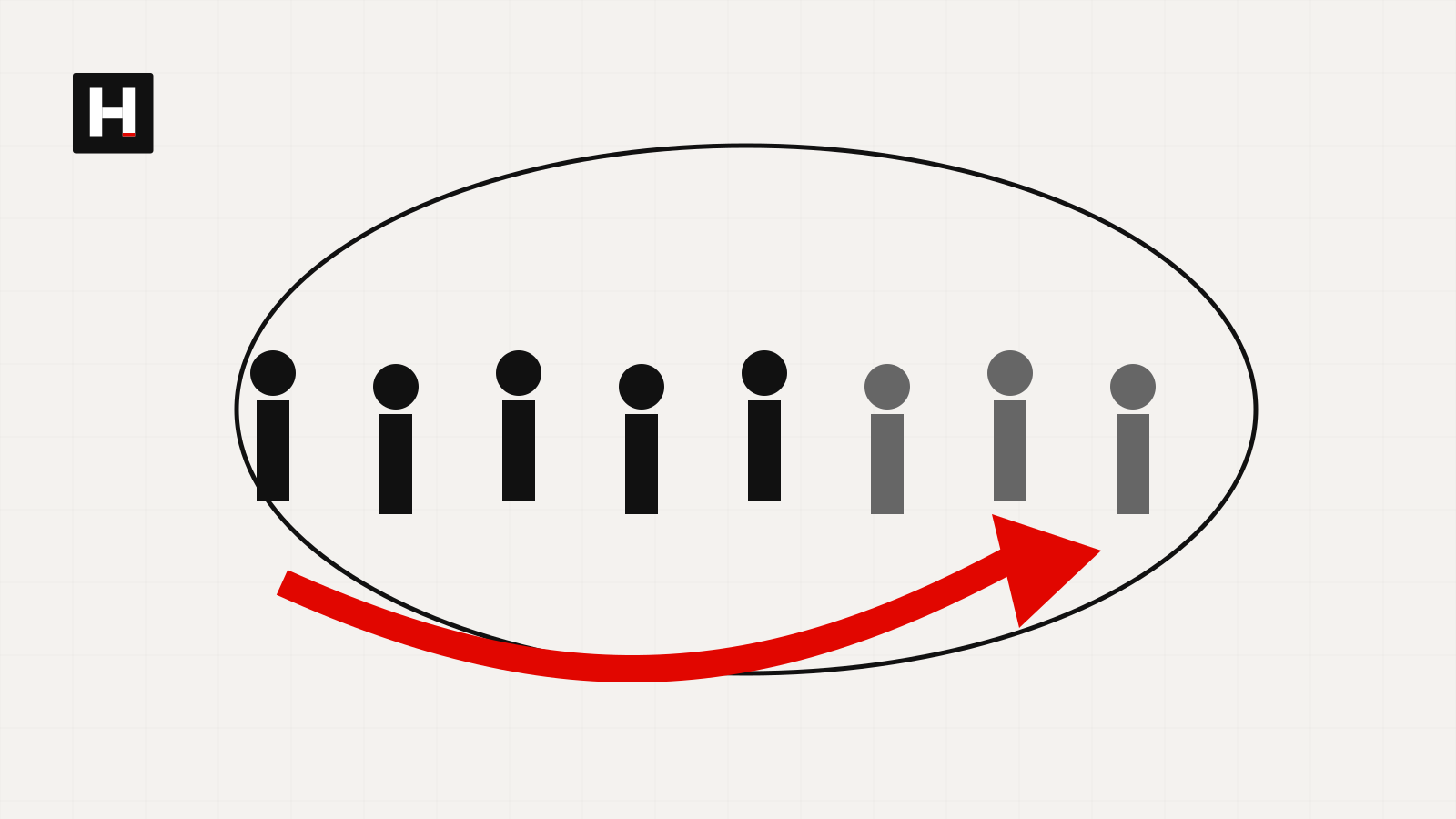
Workers Goldman Sachs classified as likely displaced by AI took about a month longer to find new work than other laid-off workers. They were roughly 10 percentage points more likely to still be unemployed a year after losing their jobs, Goldman Sachs economist Pierfrancesco Mei found in a note published Thursday, according to Fortune. Mei wrote that the effects are "comparable in magnitude" to those Goldman measured in earlier waves of technological change, damage he described as "long-lasting."
The sharper finding is where they land after rehire. AI-displaced workers are more likely than others to leave their old occupation and industry altogether. Yet when they are rehired, a larger share, "especially older ones," move into roles with similar or even higher AI exposure. Many leave the field. Far fewer leave the risk.
That echoes the history Goldman has tracked. In past waves, workers who lost jobs to technology were more likely to be rehired into more routine, less complex work, likely because the same change that eliminated their jobs had also lowered the value of their skills, Fortune reported. That is the kind of work the next round of technology could take. Goldman's earlier research, using individual-level data back to 1979, found that technology-displaced workers' real earnings grew more slowly afterward than those of other displaced workers, and their odds of another spell of unemployment stayed persistently higher.
Age splits the new cohort much as it split the old ones. AI-displaced workers 35 and older took about five weeks longer than other displaced workers to return to full-time work; for those under 35, the gap was about three weeks. Younger workers also cycled through fewer temporary jobs on the way back and were less likely to hold a second job alongside their new full-time one. Mei wrote that younger workers "may be able to adapt more flexibly to AI disruption." In the historical data, workers with shorter tenure in the job they lost also fared better, "likely because their skills were less occupation-specific and therefore more transferable," he wrote. Younger, college-educated and urban workers saw cumulative real earnings losses about half as large as other technology-displaced workers over the following decade.
Government figures for all laid-off workers show the same age gradient. The Bureau of Labor Statistics counted 7.4 million workers displaced from 2023 through 2025, up from 6.3 million in the 2021 to 2023 survey. Among those who had held their jobs at least three years, 72.9% of workers aged 25 to 54 were working again by January 2026, against 57.3% of those 55 to 64 and 38.6% of those 65 and older. Of long-tenured workers who lost full-time jobs in that period and found full-time work again, about 49% were earning as much as or more than before, down from about 62% in the prior survey.
Goldman's method was a proxy. It analyzed more than 15,000 workers in the Current Population Survey's Displaced Worker Supplement who lost jobs between 2016 and 2025. It scored each case on the occupation's AI exposure, the industry's AI adoption rate and whether the position was eliminated, and treated the top 30% as likely AI-displaced. For job losses before 2023, the year AI adoption began to rise, Goldman found no significant gap between that group and other displaced workers. The newest data, covering 2023 to 2025, "likely captures the first wave of AI-displaced workers," the bank said. It also cautioned that it is "still too early to assess the impact" across dimensions such as education and geography.
The study covers people who had a job to lose, and other research points to younger workers being hit before they get one. Stanford's Digital Economy Lab, using ADP payroll data, found in August that employment for workers aged 22 to 25 in the most AI-exposed occupations is about 19% below where it would be had it kept pace with similarly aged workers in less-exposed jobs. The adjustment "appears to operate primarily through reduced hiring of young workers rather than increased separations," wrote Erik Brynjolfsson, Bharat Chandar and Ruyu Chen. The pattern that emerges from the two studies runs in opposite directions: older workers bear more of the cost after a layoff, younger workers at the point of entry.
The scale of the economy-wide effect remains disputed. The Stanford researchers wrote that they "do not see widespread, economy-wide job displacement associated with AI," and the Yale Budget Lab has found that measures of AI exposure, automation and augmentation "show no sign of being related to changes in employment or unemployment." Employers, meanwhile, cited AI in 120,136 announced job cuts through September, about 21% of all cuts and the most frequently given reason, according to Challenger, Gray & Christmas.
A separate Goldman note a week earlier suggests these workers were displaced in relatively benign conditions. Economist Joseph Briggs found that "automation-related labor disruption is limited when the overall economy is healthy but accelerates during cyclical slowdowns," and estimated that up to 9% of workers could be "displaced during the AI transition" under the bank's forecast that AI lifts productivity by 15%. In 25 occupations that past technology upended, including photo processors, proofreaders and file clerks, employment fell an average of 25% in the five years after it began to decline, which Briggs called "likely upper bounds" for AI. Separation rates rose in 19 of those occupations; hiring rates fell in 13. Only 23% of U.S. establishments have built AI into regular workflows, according to the note, and with the economy resilient in 2026, Briggs wrote, "companies may have had less incentive to focus on aggressively cutting labor costs."
Sources (12)
Related coverage
The Morning Brief is coming soon
The HEADCOUNT
Morning Brief.
Get on the list for HEADCOUNT’s weekday briefing on the business of work.
- Weekday mornings, built from published HEADCOUNT reporting
- Evidence-backed — every item traces to sourced coverage
- The Signal: what the day's developments indicate for hiring