Canceled EV and battery projects promised 27,000 jobs. The replacements are smaller and later
New U.S. EV factory investment announcements have fallen to $2.3 billion through Aug. 24 from $54.7 billion at the 2023 peak, with about four-fifths of cancellations in states Trump won.
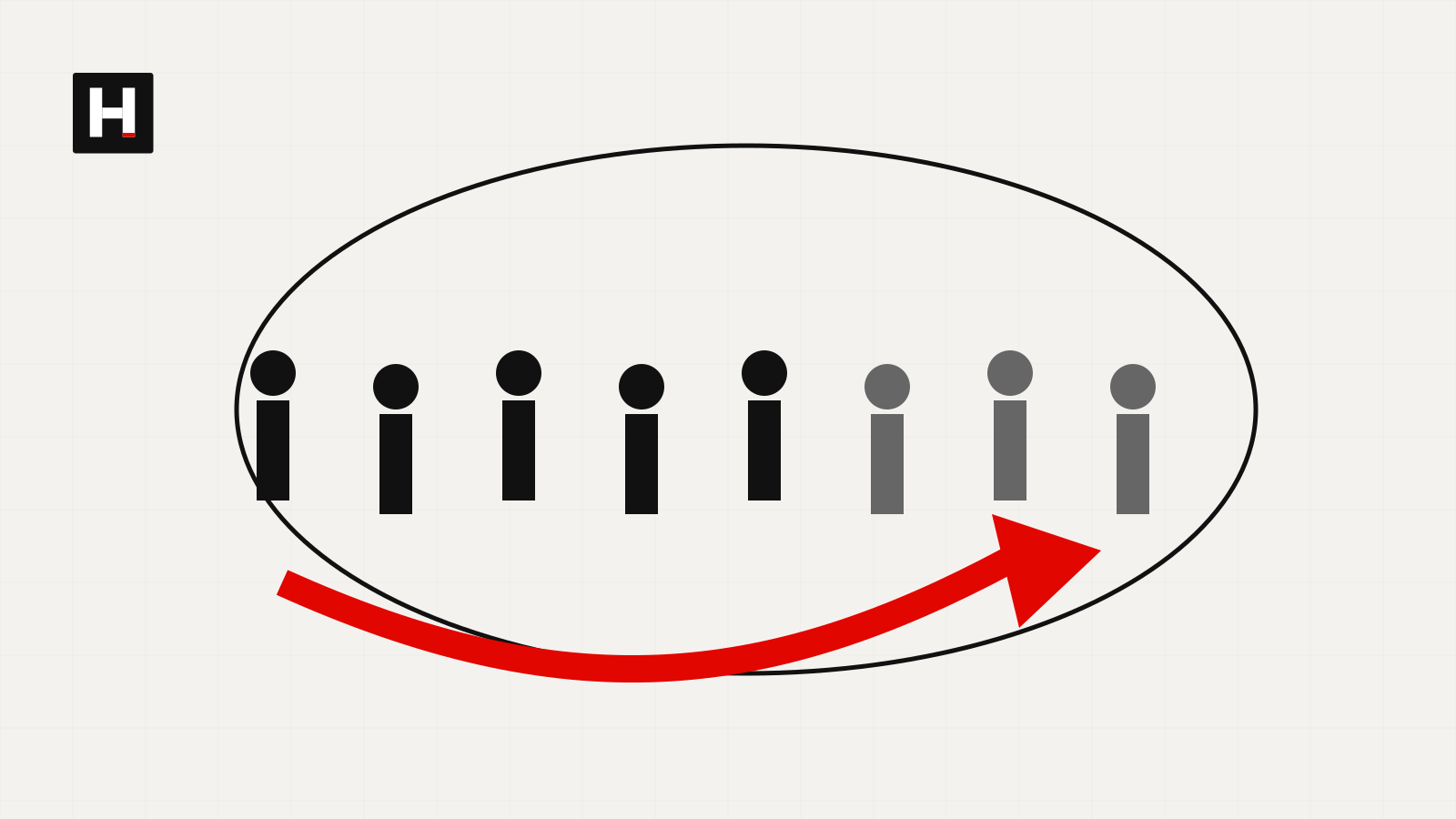
EV and battery factory projects canceled in the United States between January 2025 and August this year had promised roughly 27,000 jobs, according to a Reuters analysis of data from Atlas Public Policy, a nonpartisan tracker of clean-energy investment. The plants being salvaged are coming back with fewer workers, different products and later start dates.
New EV-related investment announcements ran to $54.7 billion in 2023 and $22.4 billion in 2024, then fell to about $6.5 billion in 2025 and $2.3 billion in the period through Aug. 24 of this year, the Atlas data show. Nearly $20 billion of projects were canceled in 2025 alone. Hiring plans of that scale do not reappear on a quarterly cycle; the factories themselves were new-build, because as James Rubenstein, a professor emeritus of geography at Miami University of Ohio, told Reuters, it was not practical to rehab an engine plant into a battery plant.
The 27,000 figure is a floor rather than a ceiling. Some project announcements in the Atlas data carried no job-creation estimate, and the tally excludes projects that were scaled back rather than killed outright, along with those where the EV portion of a broader investment could not be separated out. The damage is concentrated in a specific set of labor markets: about 87% of announced EV-related investments tracked from 2015 through Aug. 24 went to states Trump won in 2024, and about four-fifths of the canceled investments were in those states, according to the Reuters analysis.
Glendale, Kentucky, population 2,000, shows the scale-down. In 2021, Ford and South Korea's SK agreed to invest $5.8 billion there, the largest single investment in Kentucky's history, with a promise of 5,000 jobs. Local officials prepared for more than 20,000 new residents. In mid-December 2025, about 1,500 workers were laid off; one of them, Bill Wilmoth, hired in June 2024 at $21 an hour, watched a management video deliver the news from home. Ford now says it plans to hire 2,100 workers at Glendale to make energy-storage batteries, beginning in late 2027. The replacement plan is less than half the original headcount, for a different product, on a later timetable.
Lordstown, Ohio, shows what a partial recovery looks like. The GM-LG Energy Solution joint venture Ultium Cells opened a $2.3 billion cell plant there in 2022 with about 1,300 workers, enough for the area to start calling itself Voltage Valley rather than Steel Valley. Work stopped in January because of slow EV sales. About 480 employees were let go indefinitely and the remaining 850 were told they would not be needed for months, an announcement that landed weeks after Congress and the president killed the $7,500 consumer EV tax credit. The return-to-work timeline was originally six months; it slipped as demand weakened further. Production resumed in mid-August with about 700 workers recalled. About 600 remain on indefinite layoff, the company said.
Stellantis has stalled part of a $6 billion, 2,800-job battery complex in Kokomo, Indiana, planned with Samsung SDI, as part of a $27 billion writedown; Samsung SDI said it is in talks with Stellantis about the site's future. Ford's unopened Tennessee assembly plant is being switched from canceled EV pickups to gas-powered trucks, with work starting several years later than the original EV timetable.
In statements to Reuters, GM said it is "continuing to advance EVs" and still sells a dozen EV models in the U.S. LG Energy Solution acknowledged the demand slowdown after subsidies expired while calling electrification a long-term prospect. Ford CEO Jim Farley was more direct about the trigger, saying watching EV sales plummet after the credit expired last September "was really the impetus for us to make the call" on a large writedown of EV investments.
For idled battery workers, the replacement pitch is energy storage, driven by AI and data-center construction. It is a real market and a slower one for workers: Reuters reported that converting a plant tooled for EV cells to storage cells, which often use different chemistry, can take months or years, and that storage demand is not expected to come close to filling the dormant floor space built for EVs.
The replacement work that has materialized so far has not made up the difference in aggregate. U.S. auto-manufacturing employment has shrunk 1.3% since January 2025, to about 963,000 in August, federal data show, even as automakers retool idle space for gasoline programs and pull some foreign production into U.S. plants with spare capacity to avoid tariffs. Time reported separately that automotive employment has been declining about 1% to 2% a year since 2001, citing Bureau of Labor Statistics data, with steeper drops in 2025 and 2026.
One constraint has nothing to do with consumer demand. Foreign battery makers have found it harder to get specialists into U.S. plants since a September 2025 Immigration and Customs Enforcement raid on an under-construction Hyundai-LG battery factory in Ellabell, Georgia, that resulted in 475 arrests. Many of those sent home were South Korean engineers and specialists brought in for months-long stints to calibrate highly specialized machinery. Some workers in South Korea are now reluctant to travel to the U.S., setting back operations by months at several of LG's U.S. factories, two people told Reuters. LG Energy and Hyundai said in a joint statement that the Georgia plant is complete and shipped its first cells in July, and that most of its 500 workers were hired locally.
Sources (10)
Related coverage
The Morning Brief is coming soon
The HEADCOUNT
Morning Brief.
Get on the list for HEADCOUNT’s weekday briefing on the business of work.
- Weekday mornings, built from published HEADCOUNT reporting
- Evidence-backed — every item traces to sourced coverage
- The Signal: what the day's developments indicate for hiring