California emotion-AI workplace ban reaches Newsom after lawmakers narrow it
AB 1883 would bar workplace tools that infer a worker's emotions or collect neural data, with penalties of up to $500 a violation. Labor contractors and client companies are both covered.
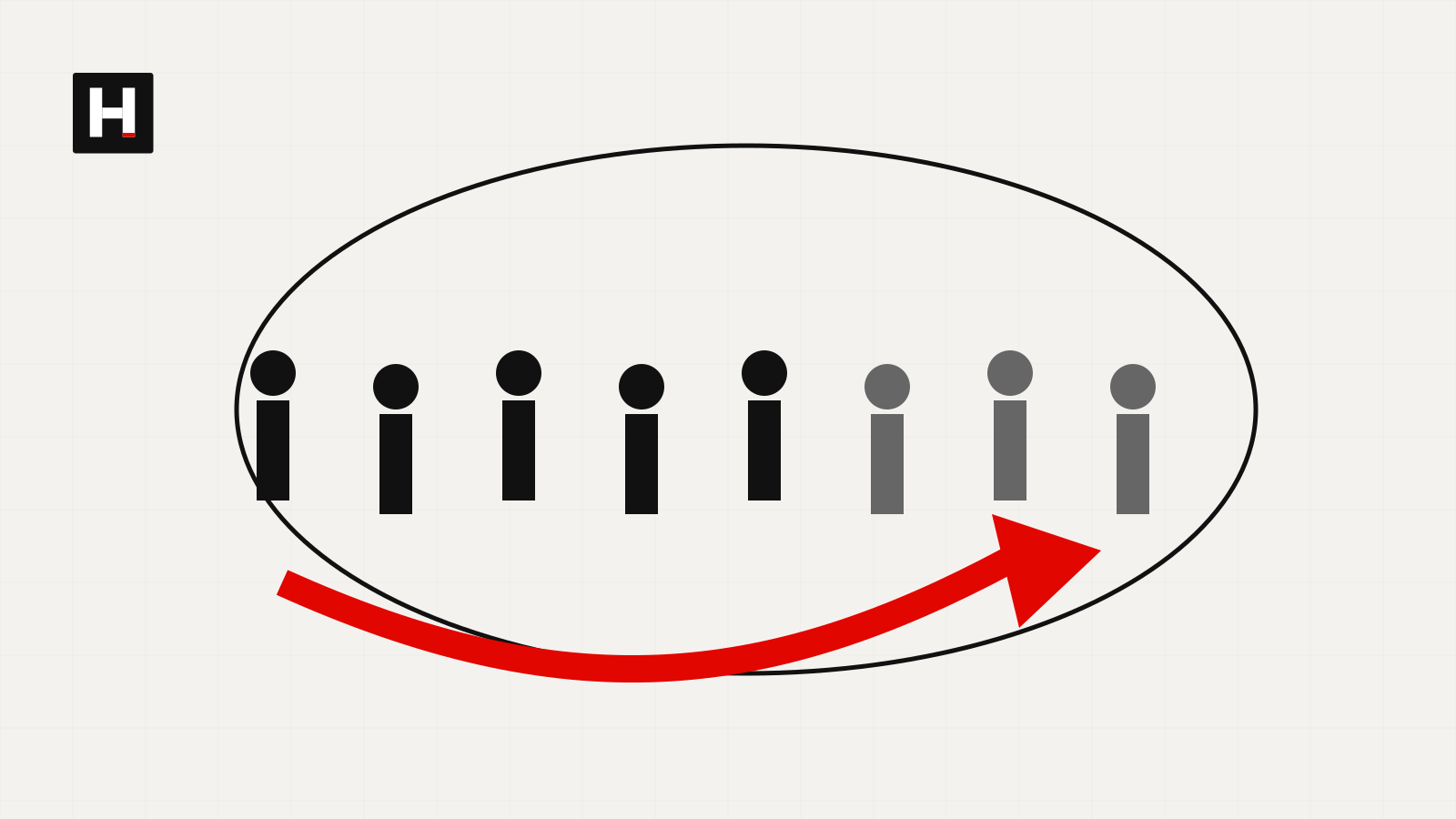
California lawmakers have sent Gov. Gavin Newsom a narrowly drawn workplace AI bill that would make it unlawful for employers in the state to use surveillance tools that recognize, infer or predict an individual worker's emotional state, or that collect the worker's neural data. Violations of Assembly Bill 1883 would carry a civil penalty of up to $500 each, enforceable by the Labor Commissioner or a public prosecutor, according to the bill summary published by CalMatters' Digital Democracy. Newsom has until September 30 to sign or veto; bills he signs typically take effect on January 1.
The narrowness is the story. Three definitional lines decide whether a given tool is legal.
The first is the source of the signal. Neural data means information generated by measuring activity in a worker's central or peripheral nervous system and not inferred from nonneural information. A fatigue product that reads brain activity through a headband sits inside the prohibition. A product that infers alertness or stress from keystroke pace or a wearable's heart-rate reading sits outside the neural-data definition, whatever the vendor's marketing says, as reported by the Los Angeles Times.
The second is the individual. The emotion prohibition attaches to recognizing or predicting an individual's emotional state. Software that scores the aggregate sentiment of a workforce across messaging platforms without identifying individuals is a different product under the bill than software that analyzes the tone of one employee's email, CXM reported.
The third is safety. Neither prohibition applies to a workplace surveillance tool used to ensure safety, and a narrower exemption covers tools reasonably necessary to comply with a federal statute, regulation or binding federal contract in aircraft development or in national security, military, space or defense work. Since much of this software is sold to employers on safety and wellbeing grounds in the first place, that exception is where the practical fight over compliance is likely to sit.
What the bill no longer contains matters to buyers as much as what it does. Earlier drafts included facial-recognition and gait-recognition provisions that were stripped out during amendment, narrowing the measure to emotion inference and neural data. Amendments adopted in the Senate on August 13 also removed the private right of action that would have let a worker or the worker's exclusive representative sue for damages, leaving enforcement with the Labor Commissioner and public prosecutors. Danielle Ochs, a San Francisco shareholder at Ogletree Deakins, told HR Executive that the bill's language "may leave the door open for representative claims under California Private Attorneys General Act (PAGA), which allows [eligible employees] to pursue Labor Code-based penalty claims on behalf of the state."
The definition of employer reaches well past private companies. It covers governmental entities including charter cities and the University of California, and it reaches labor contractors and the companies that hire through them, meaning agency and contracted staff sit inside the bill's scope rather than in a gap beside it.
Assemblymember Isaac Bryan, who introduced the measure in February, has framed it as pre-emptive. "Much of what's in our bill is cutting-edge technology or technologies that are emerging in real time, and we are trying to address easily predictable concerns before they hit the workplace," he told CalMatters.
Business and local-government opposition focused on breadth. The California Chamber of Commerce argued that the bill's definitions and its standard covering technologies capable of performing prohibited functions could sweep in ordinary security cameras and biometric safety systems, and could conflict with existing workplace-safety requirements, in a status report on major business legislation. A committee analysis records the California State Association of Counties, the League of California Cities and the California Grocers Association among opponents; the California Federation of Labor Unions sponsored the measure, with Teamsters California as co-sponsor and support from the California Nurses Association, the California Teachers Association, Privacy Rights Clearinghouse, Oakland Privacy and TechEquity.
The Assembly passed AB 1883 on May 27 by 52 to 12, and concurred in the Senate's amendments on August 30 by 56 to 8.
Newsom's record on this category is not a blank slate. In 2025 he vetoed the No Robo Bosses Act, which would have barred employers from relying solely on automated decision systems for hiring, promotion, discipline or termination decisions without human oversight, writing that it failed "to directly address incidents of misuse" and "imposes unfocused notification requirements on any business using even the most innocuous tools." The narrowing of AB 1883 through five rounds of amendment reads as a bill built to survive that objection, though whether it does is the governor's call.
Two more AI employment bills are in play this session: SB 951, which would require employers to issue notices of mass layoffs, relocations or terminations caused substantially or wholly by AI adoption, and SB 947, which would prohibit employers from relying solely on automated decision systems for disciplinary or termination decisions. Lawmakers passed 26 AI-related bills in the 2026 session, of which the governor had signed two as of early September, CXM reported.
The European Union's AI Act, in effect since August 2024, already prohibits emotion inference in workplaces and education, with carve-outs for medical and safety uses.
Sources (10)
Related coverage
The Morning Brief is coming soon
The HEADCOUNT
Morning Brief.
Get on the list for HEADCOUNT’s weekday briefing on the business of work.
- Weekday mornings, built from published HEADCOUNT reporting
- Evidence-backed — every item traces to sourced coverage
- The Signal: what the day's developments indicate for hiring